
MLA Style
how and why we format

In academia, turning in a paper without formatting it to the required style guide is like having your ideas show up to class naked. Or wearing your pajamas to a job interview. Or…doing some other thing that makes people disregard you completely before you even start speaking.
To have your ideas considered seriously by your professors and peers, you need to format them correctly. Style them how they need to be styled. And you need to learn how to correctly give credit to the words, facts, and ideas of others that you reference in your writing.
By the way, my favorite resource for answering specific questions about MLA format is the OWL Purdue MLA guide. I’ve been using it since I was an undergrad myself. I will be liberally linking specific pages throughout the rest of this post.
MLA Format: One Style of Many
Different academic disciplines have different requirements. They also have different style guides. Our style guide (and the style guide for many humanities classes) is MLA. MLA stands for “Modern Language Association” in case you’re curious.
Here’s the relevant chunk of the ACC ENG 1301 Department Syllabus:
● Faculty will teach the importance of academic honesty and will discuss documentation as a tool that varies by discipline but always supports ethical practice, heightened credibility, and continued inquiry.
● Faculty will teach the use of MLA documentation.
The difference between a correctly styled paper and an incorrectly styled one can be the difference between an accusation of plagiarism and a grade. Once you have ENG 1301 on your college transcript, your professors will be justified in assuming that you understand how to use different style guides. They will also assume that you know how to document your sources.
Let’s make sure they’re right about that.
The Three Main Categories of MLA Format
Basically, MLA gives us our guidelines for:
How our papers should look. This includes general formatting requirements, like line spacing, page numbers, font type and size, and headings.
How our citations should look. For MLA, our last page must always be the “Works Cited” page. Here, you must list the bibliographic information of the sources you’ve cited in your paper, including a link if it exists.
How to show which source specific information in our paper came from. These are called “in-text citations.” In MLA format, they are inserted into the fabric of the actual paper in parentheses.
Let’s look at these three categories one-by-one.
Category 1: Formatting
Make it look like this:
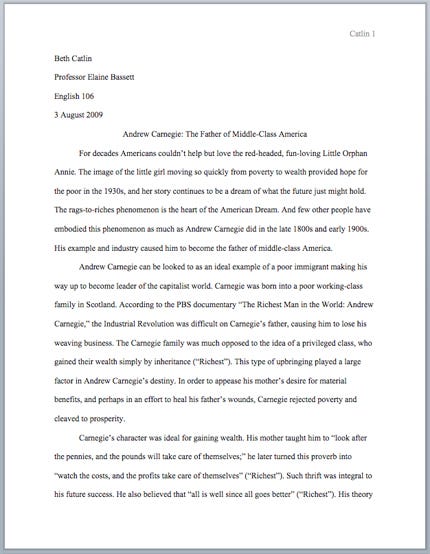
That photo is from the same OWL Purdue MLA formatting page I linked above. Go there and read through the requirements at least once. Then you can use this quick checklist to make sure that you’ve hit all the most important points.
Your essay should follow these standards:
Font: Times New Roman, 12 pt.1
Spacing: Double-spaced throughout.
Margins: 1 inch on all sides.
Indentation: New paragraphs start with a half-inch indent.
Header: Your last name + page number, right-aligned, on every page.
First Page (no cover page needed):
Your Name
Instructor’s Name [Professor Annilee Newton]
Course [ENGL 1301]
Date [Day Month Year]
Title of Your Essay (centered, not bold/italic/underlined)
Also, please note that for all the papers assigned in my class, I prefer there not be any sections and section headings.
Category 2: Works Cited page
Make it look like this:
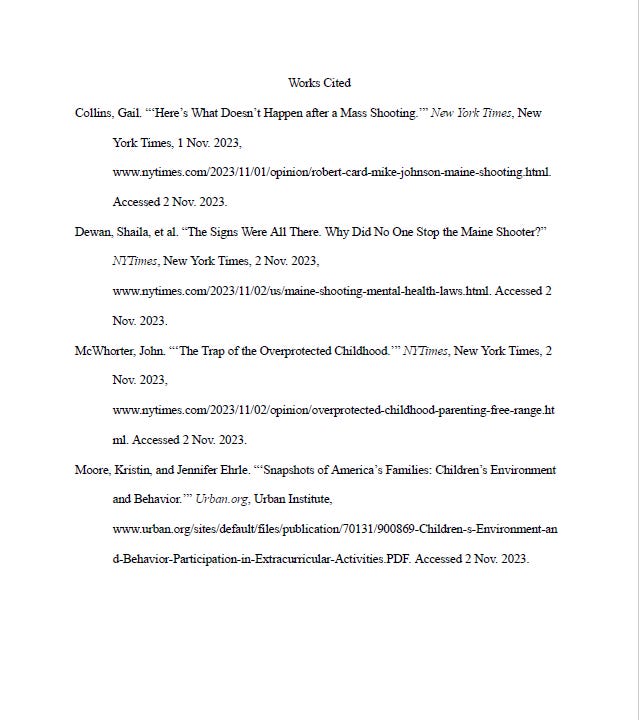
Or, even better, make MyBib make it look like that. Anytime I find myself getting frustrated with modern technology and wishing for the good old days of index cards, typewriters, and answering machines, I remember that websites like MyBib exist and acknowledge all over again that technology isn’t all bad. You do have to double check the entries, but it really makes assembling a Works Cited page much, much, much easier.
Here’s a link to the OWL Purdue MLA Citation Basics page.
Category 3: In-text Citations
Here’s another link to the relevant OWL Purdue page.
Basically, whenever you quote, paraphrase, or summarize, you need to show where the information came from. MLA uses author + page number inside parentheses.2
Basic Examples:
One author: (Smith 42).
Two authors: (Jones and Patel 16).
Three+ authors: (Ramirez et al. 5).
No author: Use a shortened title — (“Climate Change Report” 12).
With a signal phrase:
Smith argues that “students need practice integrating sources” (42).
According to Ramirez et al., the study found “strong links between…” (5).
Special Cases:
Multiple works by same author: Add title — (Smith, Language of Food 73).
No page numbers (websites): Just use the author — (Johnson).
Indirect sources (“qtd. in”): Use sparingly — (qtd. in Parker 19).
Very Helpful Resources
Purdue OWL MLA Guide (again!)
Google Docs has an MLA template. In Docs, click on Template Gallery, make sure that General is selected, and in the Education section, find the MLA Report template. Click on that and a new Google Doc will open; the new Doc will have information already typed that you will then replace with your own text, keeping the same formatting. Just please remember: no section headings for the papers assigned in my class. Just delete those.
ME!
This checklist was created with collaboration from ChatGPT.
These bullet points were also created with collaboration from ChatGPT.